Bachelor of Arts, Science and Technology (Hons)
in Individualised Major
文理及科技學士(榮譽)自訂主修
Year 1 Entry – HKDSE/ International Qualifications/ Post-Secondary
Programme Code | Duration of Study | Mode of Study | Class Start Date |

Medium of Instruction
The medium of instruction for classroom teaching (in all forms) at HKBU is English, except for those courses that are granted exemption.
Fund Type
Government Funded
First Year Intake Number
15
Credits Required for Graduation
128
Humankind is facing a more unpredictable future as technological advancement has brought disruptive changes and global problems are becoming more complex and serious. Young people need to be more adaptable, resourceful and creative in meeting future challenges. This is a future-focused programme which enables students to design their own personalised learning pathways. It is especially suitable for students who aspire to make a difference in the future world through various means, such as entrepreneurship, research, advocacy, invention and performance.
The curriculum is made up of two major components. Firstly, in the solution-based learning modules, students will go through an active and exploratory intellectual journey consisting of cycles of problem-solving. The problems are contextualised in the real-life settings and students will work in groups under the guidance of their teachers and external specialists. Secondly, students will complete a major which gives them in-depth knowledge in one or more specific domains of their choice and prepares them for further study.
The programme is open to students from all academic backgrounds.
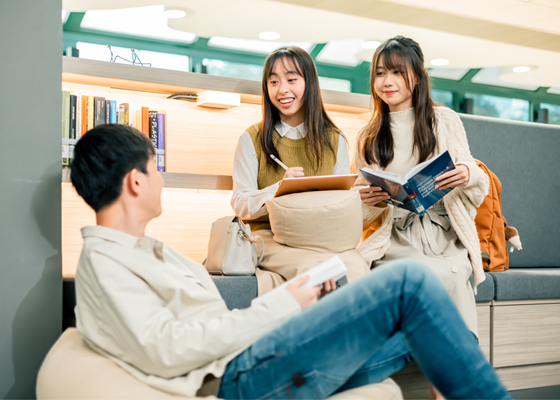
The solution-based learning modules use a block design, which immerses students in one set of coherent learning activities around a problem at a time. The modules are student-centred, and guided by professors and/or professionals, and aim to facilitate deep learning toward addressing real problems. In the early years of the programme, the problems are smaller, more well-defined, and there will be more faculty guidance. As students proceed, the problems will become bigger, less well-defined, and students will become more independent with less faculty supervision. Examples include finding ways to provide support to care takers of elderly people (Year 1 or 2), revitalizing a heritage (Year 3), and making steps toward feeding the world population (Year 4). Students will play active roles in choosing the problems in the solution-based learning modules, as well as the approaches to solve these problems. The programme will give students ample autonomy and flexibility in designing their modules and curricula.
Students will benefit from a number of guided self-learning pedagogies in the programme such as service-learning, collaborative learning and research-led learning. Depending on the problems they choose, they will work intensely with community partners, professionals, artists and entrepreneurs. In addition to joining internships and exchanges outside Hong Kong, they will work with overseas students and advisors in joint projects and learning activities such as summer schools.
Graduates will be resourceful and innovative problem-solvers and have a dedicated personal mission. They may become entrepreneurs, consultants, researchers, or artists, among other options. Their skills and abilities will enable them to take on multiple careers, which will be a trend in the future society, and make them especially competitive in jobs or industries that are yet to emerge.
LO Wei Yin Nadia
Bachelor of Arts, Science and Technology in Individualised Major (Year 4)
Over the past three years I have grown through learning, reflection and sharing as a student of HKBU’s Bachelor of Arts, Science and Technology (Hons) in Individualised Major (BAScT). The programme’s transdisciplinary and personalised structure has let me design a pathway that connects media design, sustainability and social innovation.
I am especially grateful for the semester-break experiences made possible by BAScT. A media-design internship that showed how visual language can carry complex issues; time at WWF where conservation science met campaign storytelling; and work with media companies that asked me to turn specialist knowledge into public narratives.
They were part of how BAScT trains students to treat design, ecology, policy and media as one working system. it gives me the freedom to explore different interests while providing a structure that brings them together into a meaningful academic journey.
JUPAS - General Entrance Requirements
Programme Entrance Requirements
Programme Requirements
| HKDSE Core Subject(s) | Minimum Level |
|---|---|
| CHINESE LANGUAGE | 3 |
| ENGLISH LANGUAGE | 3 |
| CITIZENSIP AND SOCIAL DEVELOPMENT | Attained |
| MATHEMATICS COMPULSORY PART | 2 |
| Elective Subject(s) | Minimum Level |
| ANY 2 SUBJECTS Notes | 3 |
Notes for elective subjects:
1) One of the electives must be any Category A subjects (excluding Extended Part of Mathematics (Module 1 or Module 2));
2) The other elective can be any of the following subjects:
a) Category A subjects (including Extended Part of Mathematics (Module 1 or Module 2));
b) Category B (Applied Learning) subjects with "Attained with Distinction (I)" or above;
c) Category C (Other Language) subjects.
Please refer to the following link for the details of General and Programme Entrance Requirements
Remarks on other requirements:
Applicants are required to submit a portfolio and to attend an interview.
International Qualifications - Programme Entrance Requirements
Applicants are required to submit a portfolio via an online portfolio submission system. Applications without portfolio submission will not be further processed. For details on submitting your portfolio, please visit: https://transdisciplinary.hkbu.edu.hk/plp/portfolio_submission_guidelines(NON-JUPAS).pdf?5.
Post-Secondary Qualifications - Programme Entrance Requirements
Applicants are required to submit a portfolio via an online portfolio submission system. Applications without portfolio submission will not be further processed. For details on submitting your portfolio, please visit: https://transdisciplinary.hkbu.edu.hk/plp/portfolio_submission_guidelines(NON-JUPAS).pdf?5.
提交作品集及面试安排
- 凡获邀参加面试者须参与面试。
- 课程将于6月中下旬发送电邮予获邀的考生,以通知有关的面试安排。
- 面试将以在线形式(Zoom)进行。
- 作品集要求细则请见 附件。
Programme Contact Information
Enquiry
Division of Transdisciplinary Undergraduate Programmes